
Estimated reading time: 6 min read
Choosing the best POS system for a small business in Malaysia means looking beyond the initial sticker price. The system should fit day-to-day needs, support local payment methods, and remain suitable as the business grows. For many small businesses, the move from one shop to a second outlet is when the limits of a basic cash register or entry-level POS become clear.
According to SME Corp Malaysia, a small business in services and other sectors has annual sales turnover from RM300,000 to below RM3 million, or between 5 and fewer than 30 full-time employees. Whether you run a cafe, a salon, or a retail trading business, your choice of technology today will dictate your operational capacity tomorrow. Choosing a system built for growth is not a luxury; it is a financial necessity to avoid the disruptive costs of a second system migration.
The Hidden Costs of “Cheap” POS Systems
When evaluating technology, it is tempting to focus solely on the lowest upfront cost. However, comparing POS systems purely on their initial price tag often overlooks the significant expenses incurred when a business outgrows its software. A system that looks affordable for a single till can become a liability during expansion.
The first hidden cost is data migration. When a business is forced to switch systems mid-expansion, they must re-enter all stock, customer details, and historical data into the new platform. This process is time-consuming and prone to error. Second, there is the requirement for staff retraining. Every time a new system is introduced, time must be diverted from sales to teaching employees how to operate the new interface, which can temporarily impact customer service and efficiency. Finally, there is the risk of hardware replacement. A cheap system may not be compatible with the more advanced hardware needed for larger operations, leading to wasted capital.
The goal for any growing enterprise should be to avoid a second system migration within a few years. A system that is built to scale from day one is often more cost-effective than one that forces a costly rebuild during a period of expansion.
Essential Features for Malaysian Business Growth
As a small business expands, its operational needs shift from basic checkout speed to the need for centralised control. To manage this transition effectively, several key features are required.
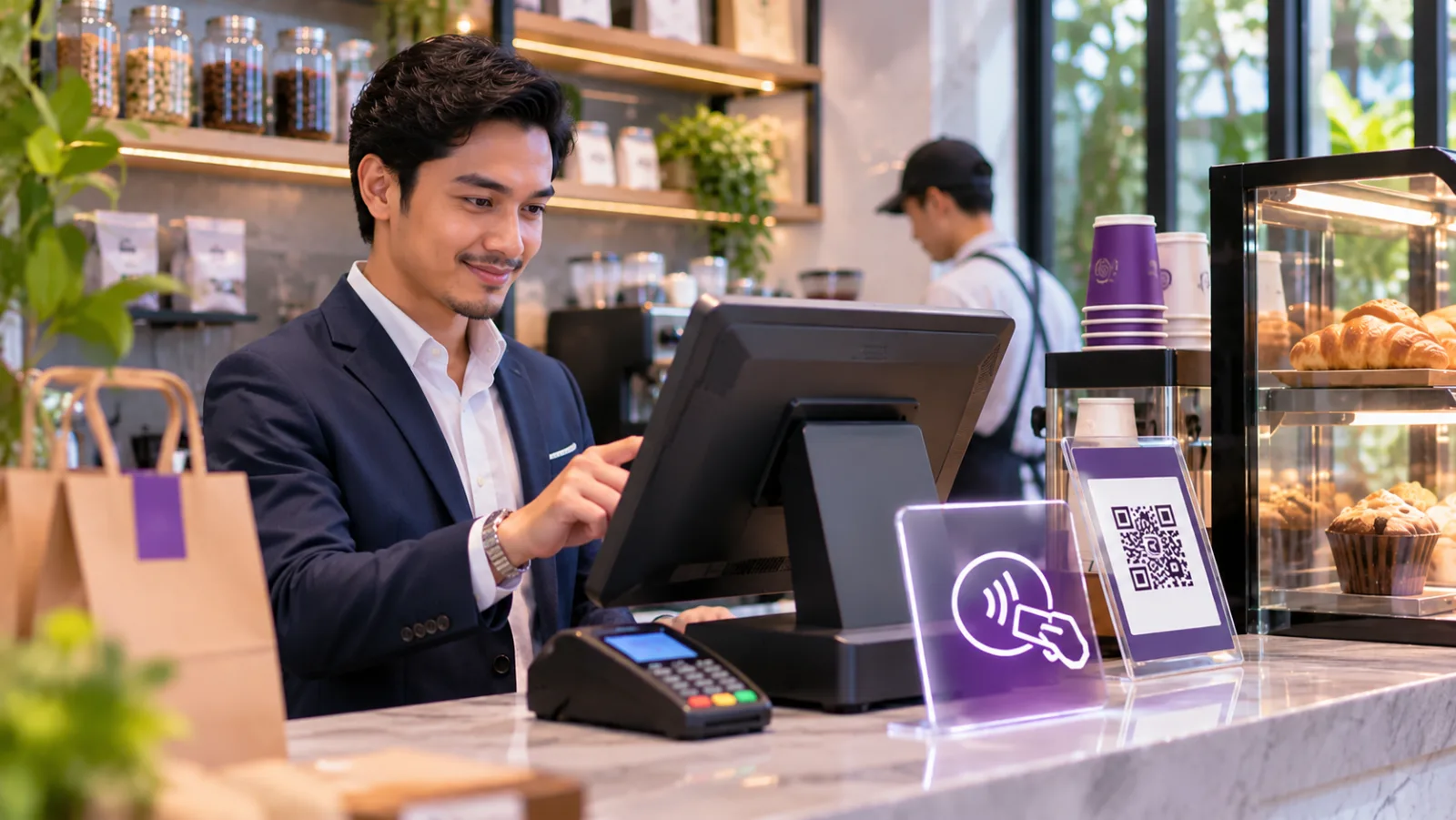
Local payment integration is a non-negotiable requirement for the Malaysian market. Customers expect to pay via DuitNow QR and various local e-wallets. A system that integrates these methods natively allows you to accept common payment forms without the need for additional, separate card machines or apps.
Centralised visibility is the second pillar of growth. Once you move beyond a single outlet, owners need to see sales, stock, and staff performance across every branch through a single dashboard. Relying on individual outlet managers for manual updates is inefficient and increases the risk of misinformation. A centralised system allows for consistent pricing and promotions across all locations, ensuring your brand remains uniform.
Finally, ease of use is vital. Small businesses rarely have dedicated IT departments. A system must be straightforward enough that staff can be trained quickly, ensuring that daily operations remain smooth and that technical hurdles do not interfere with the customer experience.
Navigating LHDN E-Invoice Compliance
One of the main regulatory points for Malaysian SMEs is understanding whether their business must issue e-Invoices. LHDN’s implementation timeline, updated on 30 August 2026, states that taxpayers with annual turnover or revenue below RM3 million are exempt from e-Invoice implementation, subject to the published eligibility criteria. This is not a services-only exemption.
The General FAQ explains that the exemption also depends on business and group structure. The tests include whether the taxpayer has a non-individual shareholder with annual revenue of RM3 million or more, is a subsidiary of a holding company with annual revenue of RM3 million or more, or has a related company or joint venture with annual revenue of RM3 million or more. A business should check these conditions rather than relying only on its own turnover.
LHDN’s phased schedule lists taxpayers with annual turnover or revenue above RM5 million and up to RM25 million for implementation from 1 July 2025. The group with turnover or revenue up to RM5 million was listed from 1 January 2026, with the below-RM3 million exemption applying to eligible taxpayers. This means businesses between RM3 million and RM5 million should check the implementation date and any applicable transitional treatment under the current guidance.
The distinction also matters for manufacturing SMEs. SME Corp’s small-enterprise category can extend to annual turnover of RM15 million, but SME classification and LHDN’s e-Invoice thresholds serve different purposes. A manufacturer with turnover above RM5 million and up to RM15 million can fall within LHDN’s above-RM5-million to RM25-million phase. Business owners should check their turnover, entity structure and the current LHDN guidance before deciding whether e-Invoice applies to them.
Cloud-Based vs On-Premise: A Total Cost of Ownership Perspective
Choosing between a cloud-based and an on-premise POS system is a significant decision that impacts the total cost of ownership.
Cloud-based POS systems are generally more affordable for growing businesses in the short term. Because they do not require a dedicated local server, upfront capital expenditure is lower. Updates are handled centrally, which can reduce the need for in-house technical support. This makes cloud systems highly suitable for businesses that plan to add multiple outlets.
On-premise systems, conversely, may be more suitable for businesses operating in areas with highly unreliable internet connectivity, as they function without a constant online connection. However, they often come with higher maintenance costs and can be more difficult and expensive to scale when adding new branches. For most modern SMEs looking to expand, the flexibility and lower total cost of a cloud-based setup provide a clearer path to growth.

Assessing a POS System for Future Growth
A practical way to assess scalability is to map how day-to-day processes may change as a business expands. A single outlet may focus on checkout speed and basic stock records. With several outlets, owners may need consistent product information, pricing, permissions and consolidated reporting. Before choosing a system, document which tasks should remain consistent across branches and which can be managed locally.
The assessment should also cover staff onboarding, support arrangements, data access, export options and the process for adding new outlets. Ask each provider to demonstrate these workflows using scenarios that reflect the business, rather than relying on broad marketing claims.